
Is Los Angeles Finally Ready to Take Its Commute to the Sky?
For a city built around the automobile, Los Angeles has spent decades trying to escape its own traffic. Freeways became wider, helicopters became a luxury shortcut and ride-hailing promised to make getting around easier. Yet the fundamental problem remains: too many people, too many cars and not enough road.
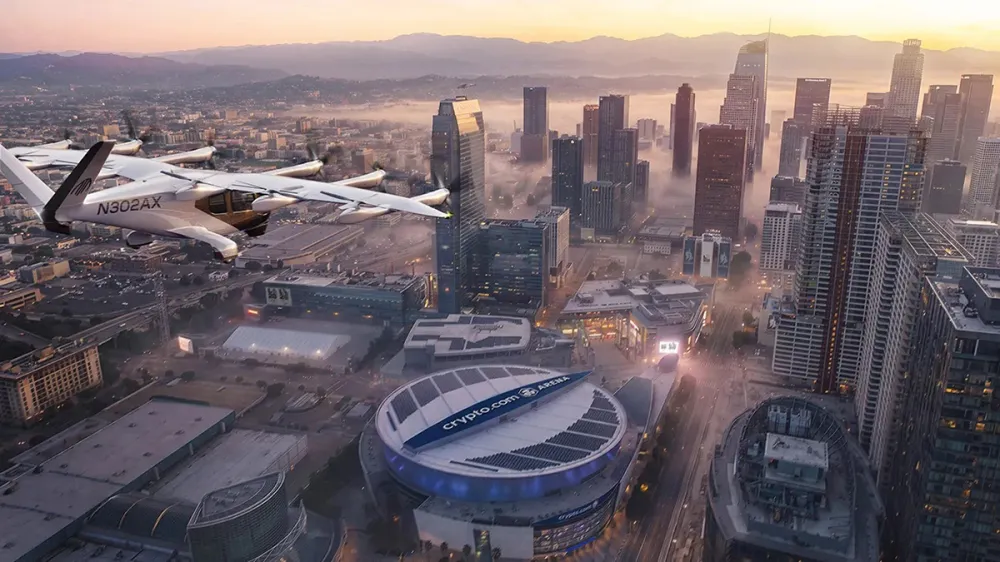
Now, Los Angeles is preparing to try something considerably more ambitious. As reported by The Hollywood Reporter, AEG and Archer Aviation have announced a multiyear partnership to develop downtown Los Angeles’ first vertiport at L.A. Live, potentially bringing electric air taxis directly into one of the city’s busiest entertainment districts. The Hollywood Reporter report via Robb Report
The proposition is almost comically simple. Instead of spending up to two hours navigating Los Angeles traffic to get from one part of the city to another, passengers could eventually board an Archer Midnight electric aircraft and make the journey in roughly 10 to 20 minutes. The aircraft is designed to carry four passengers, reach speeds of up to 150 mph and operate with significantly less noise than a conventional helicopter while producing no operating emissions.
For a city where traffic can turn a relatively short journey into an afternoon-long ordeal, the appeal is obvious. Imagine leaving LAX, USC, Santa Monica or Hollywood and arriving downtown without ever encountering the 405.
Archer is already developing a broader Southern California network that is expected to connect locations including SoFi Stadium, USC, LAX, Hollywood Burbank Airport and destinations in Santa Monica and Orange County. Hawthorne Airport, which Archer recently acquired, is intended to serve as the network’s operational centre.
The timing is also significant. Archer has been named the official air taxi provider for the 2028 Los Angeles Olympics and Team USA, meaning the technology is being positioned not simply as a futuristic experiment but as part of the infrastructure surrounding one of the world’s largest sporting events. With downtown Los Angeles expected to host numerous Olympic and Paralympic events, the proposed L.A. Live vertiport could become an important demonstration of what urban air mobility might look like at scale.
There is, however, a considerable gap between announcing a vertiport and actually operating one. AEG and Archer have completed an initial feasibility study covering land use, airspace, power availability and community impact, while further work is underway to determine operations and the passenger experience. The precise location of the landing site has yet to be decided.
That last detail matters because the future of urban air mobility will ultimately depend on more than the aircraft itself. Los Angeles will have to decide where these machines can fly, where they can land, who gets to use them and how much they will cost. If air taxis become an expensive alternative available primarily to wealthy travellers attending games and concerts, they may do little to solve the city’s transportation problems.
But if the technology can eventually become quiet, reliable and accessible enough to complement public transportation, something more interesting could happen. Los Angeles may begin to develop a transportation system in which the most valuable piece of infrastructure is no longer another lane of asphalt, but a small piece of the sky.
For a city that has spent generations trying to beat the traffic, perhaps the next move was always going to be to simply fly over it.




Leave a Reply